

Most businesses don’t fail because they choose the wrong idea.
They fail because execution falls apart.
That’s exactly why agentic AI is getting attention. It promises to take execution off your plate and keep things moving without constant effort.
But here’s the catch.
Just deciding to implement it isn’t enough. The way you implement it determines whether it works or becomes another stalled project.
So let’s walk through how to actually do this right.
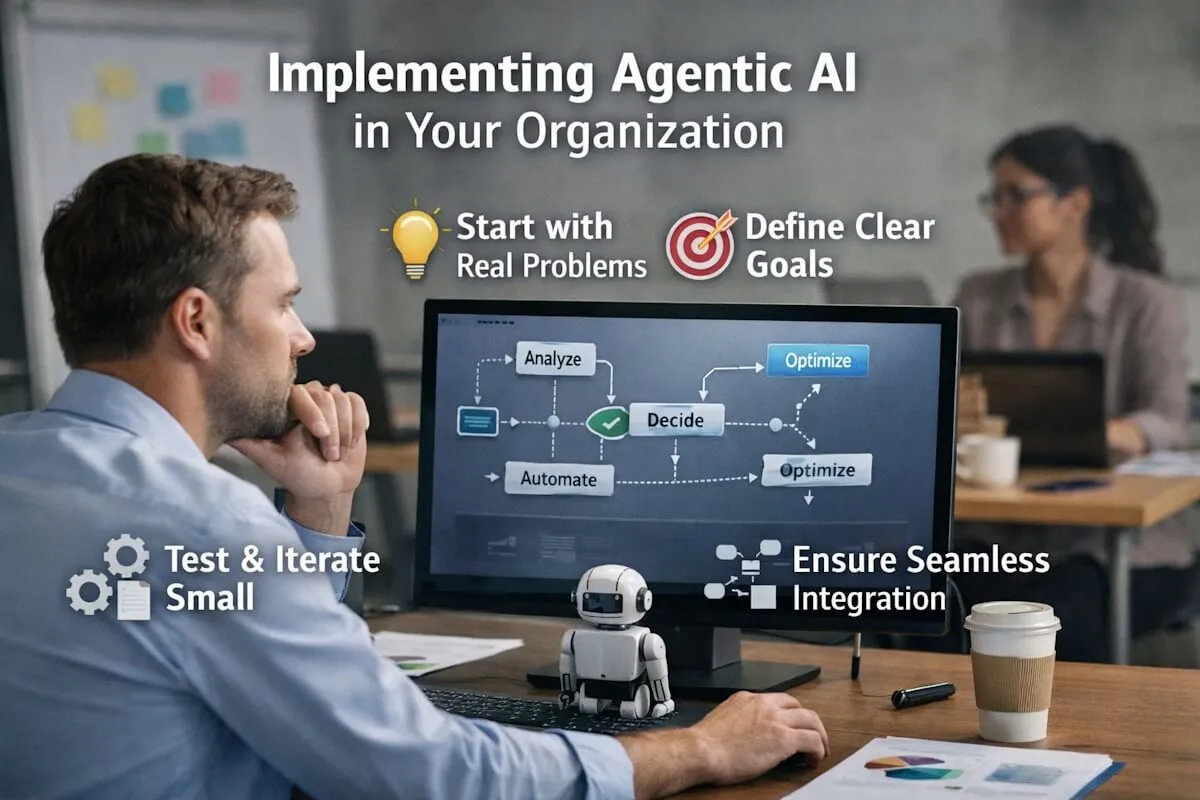
Start with a clear problem, not the technology
It’s tempting to begin with the tech.
“What can we build with this?”
That’s the wrong starting point.
Instead, ask:
- Where are we losing time daily?
- Which processes feel repetitive?
- Where do tasks get stuck?
These are your entry points.
Agentic AI works best when tied to real operational problems, not abstract ideas.
Define outcomes before workflows
Don’t jump straight into building workflows.
First, define what success looks like.
For example:
- Reduce response time in customer support
- Increase lead follow-up consistency
- Improve task completion rates
Be specific.
If the outcome is unclear, the system won’t perform well.
Agentic systems depend on clear goals. Without that, execution becomes messy.
Start small, but start right
A common mistake is trying to automate everything at once.
That creates confusion.
Instead:
- Pick one workflow
- Keep the scope limited
- Focus on getting it right
Once it works, you can expand.
This approach reduces risk and gives you faster results.
Map your existing workflow properly
Before changing anything, understand what you already have.
Break down:
- Each step in the process
- Who is responsible
- Where delays happen
- Where decisions are made
This helps you design better systems.
Skipping this step often leads to poor execution later.
Design decision paths carefully
Agentic AI is not just about actions.
It’s about decisions.
Your system needs to know:
- When to proceed
- When to pause
- When to escalate
- When to change direction
This requires structured thinking.
You’re not just automating tasks. You’re defining how the system behaves.
Ensure system connectivity early
Your agentic system will need access to data and tools.
CRMs, databases, communication platforms.
Make sure:
- Data flows are clear
- Integrations are stable
- Actions trigger correctly
If systems don’t connect properly, execution breaks down.
This is one of the most common issues businesses face.
Build in control and visibility
You don’t want a system that runs blindly.
And you don’t want to monitor every step either.
Find the balance.
Make sure you can:
- Track actions
- Review outcomes
- Step in when needed
Good systems provide visibility without slowing things down.
Test in real scenarios, not just ideal ones
It’s easy to test workflows in perfect conditions.
But real-world situations are messy.
Test for:
- Incomplete data
- Unexpected inputs
- System failures
This helps you identify gaps early.
And it prevents issues after deployment.
Expect adjustments after launch
Your first version won’t be perfect.
And that’s okay.
Agentic systems improve over time.
You’ll need to:
- Monitor performance
- Identify weak points
- Refine decision paths
Treat it as an ongoing process, not a one-time setup.
Train your team alongside the system
This part often gets ignored.
Your team needs to understand:
- What the system does
- When to trust it
- When to step in
If your team doesn’t trust the system, adoption slows down.
Keep communication clear.
Make them part of the process.
Avoid over-automation
Not everything should be handled automatically.
Some decisions still need human judgment.
Identify:
- High-risk processes
- Sensitive tasks
- Complex decision areas
Keep humans involved where it makes sense.
Balance is key.
Why working with the right partner helps
Implementing agentic AI involves multiple moving parts.
Design, integration, testing, refinement.
That’s why businesses often rely on Agentic AI Development Services to guide the process.
Instead of trial and error, you get structured execution.
That saves time and reduces risk.
The role of skilled developers in implementation
The quality of your system depends on the people building it.
When you Hire AI Agent Developers, you’re not just getting technical support.
You’re getting:
- Better workflow design
- Clear decision structures
- Reliable execution paths
This makes implementation smoother and more effective.
Common mistakes to avoid
Let’s keep this practical.
Avoid:
- Starting without clear goals
- Automating too many processes at once
- Ignoring edge cases
- Skipping testing
- Expecting instant results
These mistakes slow progress.
And they’re completely avoidable.
What success looks like over time
You won’t see overnight change.
But gradually, you’ll notice:
- Fewer delays in workflows
- Less manual effort
- More consistent execution
- Better use of your team’s time
That’s when the real impact starts showing.
Where you should begin right now
Don’t overthink it.
Pick one process.
Define the outcome.
Map the workflow.
Start there.
You don’t need a perfect plan. You need a starting point.
The bigger shift behind implementation
This is not just about adding new systems.
It’s about changing how work happens.
From manual execution to goal-driven action.
From constant supervision to structured autonomy.
That’s a big shift.
And it doesn’t happen overnight.
So, are you ready to implement it the right way?
You can treat agentic AI as just another tool.
Or you can use it to rethink how your business executes work.
The difference comes down to how you approach implementation.
Because at the end of the day, success is not about adopting new technology.
It’s about making it work for your business in a way that actually delivers results.